AI in the SDLC: Why the Bill for Cutting Juniors Comes Due in 2030
I am currently navigating what an AI-native SDLC actually looks like in practice, both in my own work and in how I read the broader market. The research I pulled together for this post pointed at something I was not expecting. The most defensible-looking AI hiring strategy on a spreadsheet, the one where you cut junior headcount, lean on AI tooling to fill the gap, and keep your seniors, is also the most expensive one nobody is pricing correctly. The productivity numbers from vendors back it up in the short term. In three to five years, the orgs that picked it will be paying senior recruiters whatever they ask for, because they will have no internal pipeline left to negotiate against.
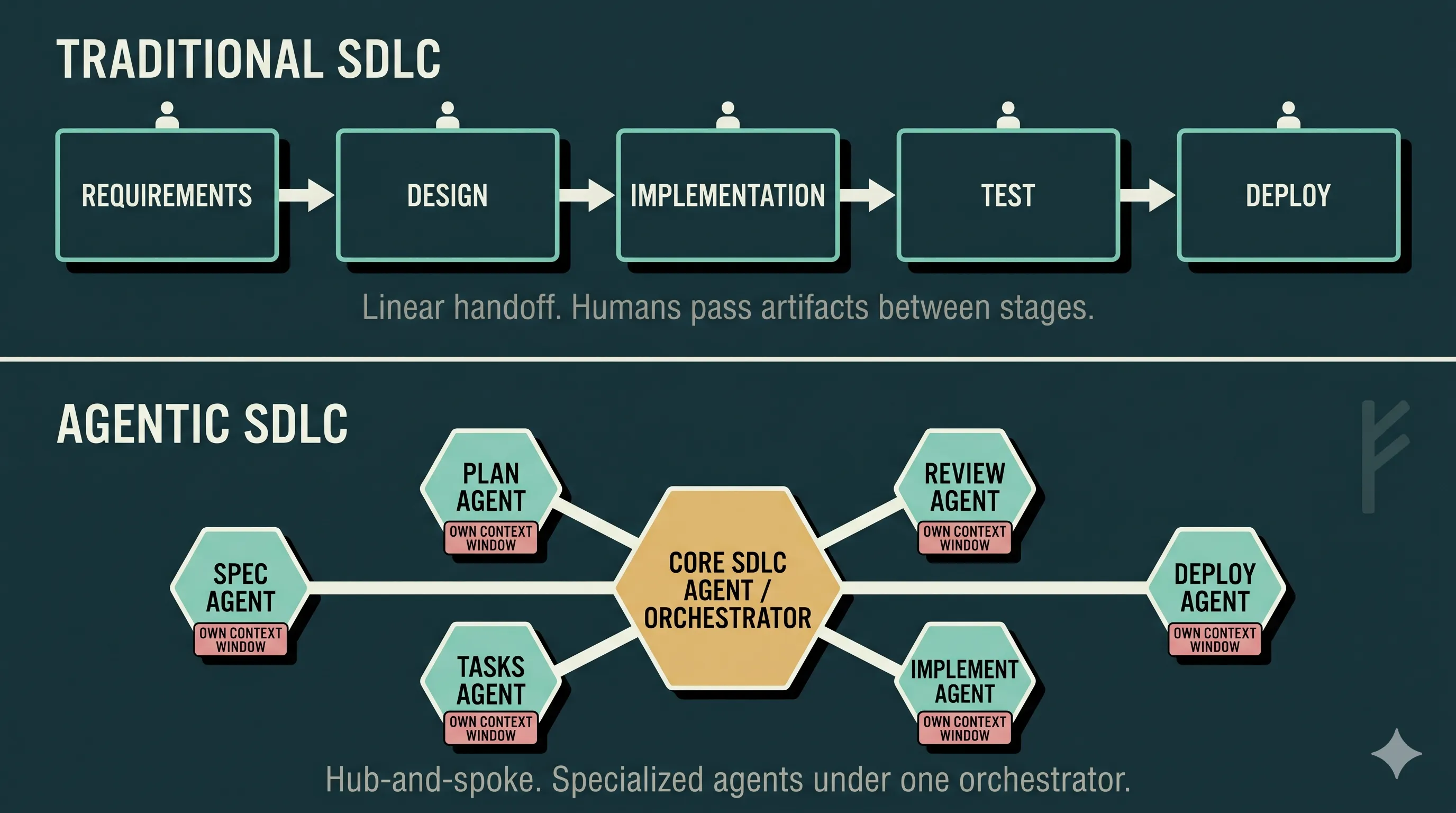
The 2025 shift was less about a model release and more about a change in unit of work. AI moved from assisting developers to acting as developers. Each phase of the SDLC is increasingly an agent under an orchestrator instead of a handoff between humans. That structural shift is real, and the gain from it lands very differently depending on where you sit on the seniority curve.
The asymmetric impact, and why most leaders are reading it backwards
The dominant pattern in the research I gathered, and in how engineering leadership commentary is framing the AI strategy debate, is some version of: AI is going to displace junior work first, so we should hire fewer juniors. The data backs the first half of that sentence. The conclusion is exactly wrong.
MIT Sloan research on the GitHub Copilot rollout across Microsoft, Accenture, and a Fortune 100 manufacturer found junior developers see 27-39% productivity gains with AI tools. Seniors see 8-13%. Brynjolfsson's "Generative AI at Work," published in QJE, found a similar shape in customer support: less-skilled workers gained roughly 30% in issues resolved per hour while higher-skilled workers showed little measurable effect. AI flattens the curve. It does not lift the top.
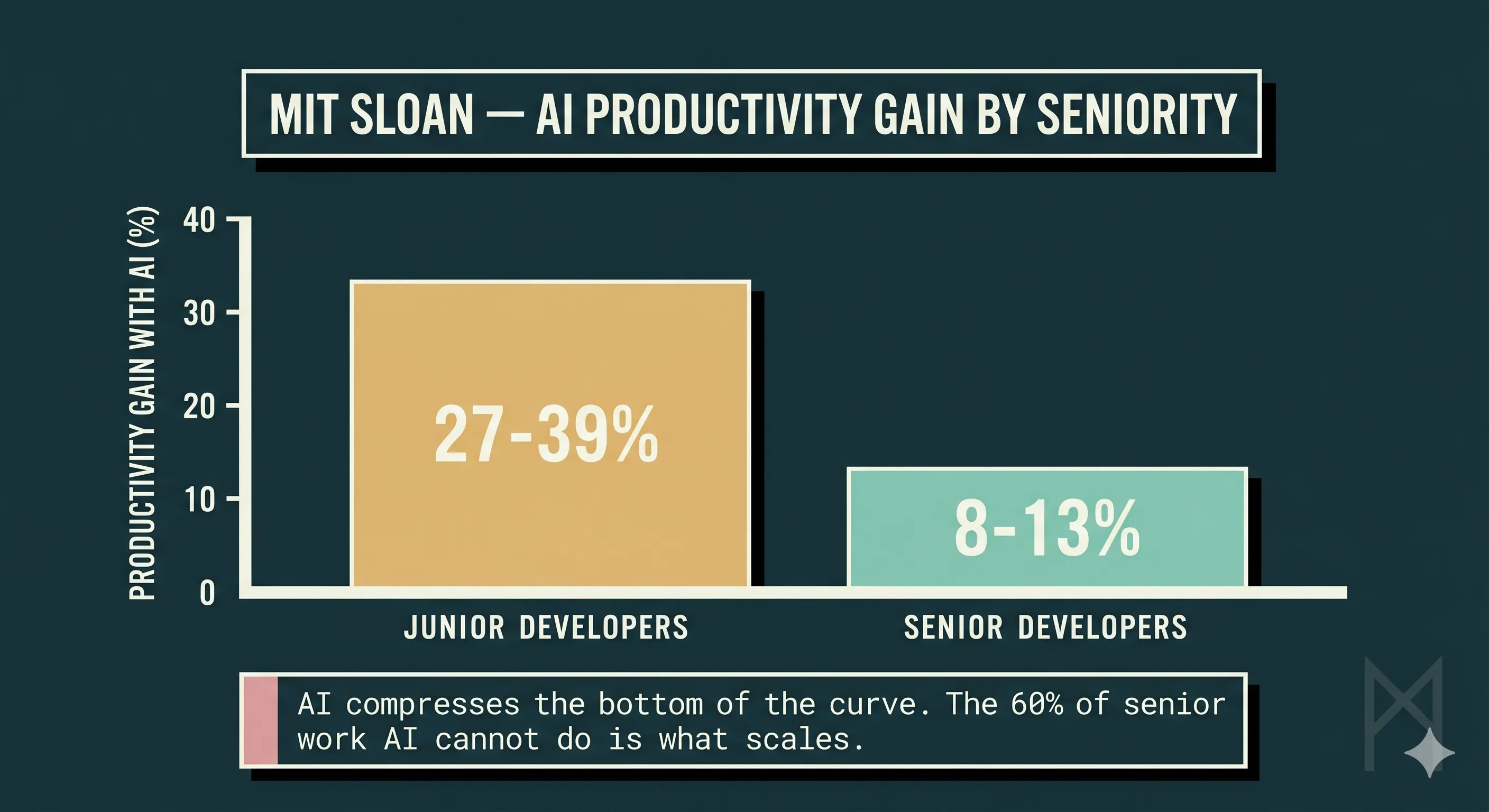
The naive read is "AI is doing the typing-heavy work juniors used to do, so cut the headcount and buy seats instead." The accurate read is the opposite. AI accelerates the smallest part of senior work, which is typing, and leaves the largest parts untouched. Architecture, judgment, operations, mentoring, business translation, security trade-offs, regulatory exposure: the model can advise on all of it and act on none of it without a senior in the loop. That ratio of AI-acceleratable work to non-acceleratable work is where senior leverage actually lives, and it has gone up, not down.
Cursor's own data on adoption mix tells the story in workflow signals. Junior developers accept Tab autocomplete more often: typing assistance, line-level. Senior developers accept agent-mode output more often: delegation of structured work where they have already decided the shape of the answer. Anthropic's 2026 Agentic Coding Trends Report measured developers using AI in roughly 60% of their work but able to fully delegate only 0-20% of tasks. The 60-vs-20 gap is exactly where senior judgment lives.
Charity Majors, CTO at Honeycomb, puts it directly: senior engineering is "not primarily a function of your ability to write code." It is about the ability to "understand, maintain, explain, and manage a large body of software in production over time." AI has not "done a thing to aid in the work of managing, understanding, or operating that code. If anything, it has only made the hard jobs harder." Even the vendors say so. Cognition's 2025 performance review for Devin admits: "Like most junior engineers, Devin does best with clear requirements and can't independently tackle an ambiguous coding project end-to-end like a senior engineer could." The vendor selling the product is telling you the product is a mid-junior IC.
The pipeline is collapsing in real time
If the asymmetric-impact thesis is right, the rational org strategy is to deliberately overweight junior hiring relative to where the market is going. The market is doing the opposite, in measurable ways.
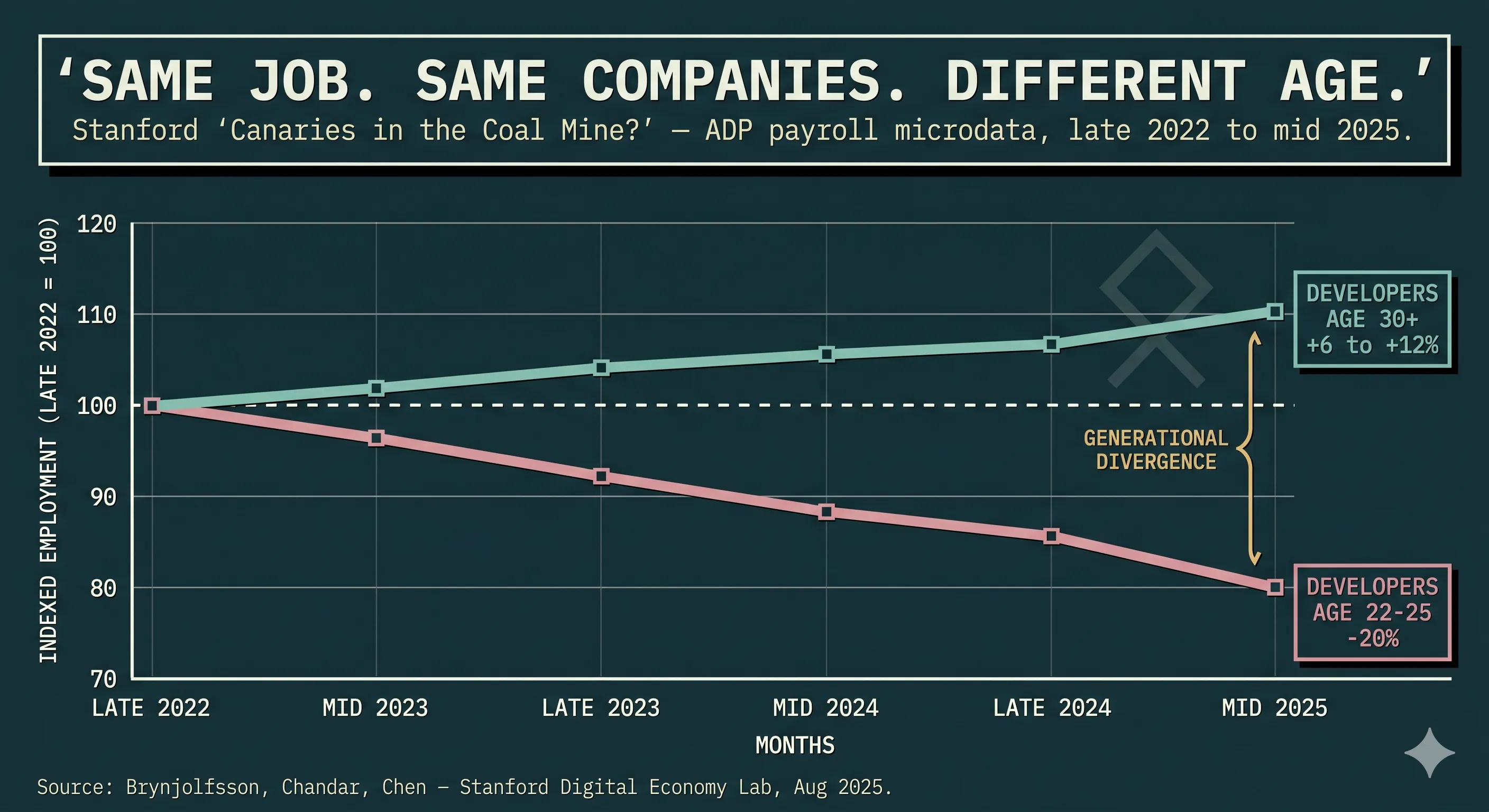
Stanford's "Canaries in the Coal Mine?" paper, updated November 2025 by Brynjolfsson, Chandar, and Chen, used ADP payroll microdata covering millions of workers and tens of thousands of employers. Employment for software developers ages 22-25 fell roughly 20% from the late-2022 peak. Workers 30+ in the same roles were stable or growing. Wages did not adjust: drops show up in headcount, not pay. Companies are not laying juniors off. They are not opening the seats.
Indeed Hiring Lab corroborates from the demand side. Standard (junior) titles are down 34% from February 2020; senior titles down 19%. Juniors took roughly double the hit, and the concentration is unique to tech. Indeed's honest caveat: about half the tech-posting decline pre-dates ChatGPT, so AI is at most a contributor. Indeed frames AI as "preventing a bounce-back" rather than driving the initial drop. Either way, the net effect on a 22-year-old computer science graduate is the same.
There is a structural argument seniors should care about most. If your org cuts juniors aggressively to lean on AI, eval(code)'s "If You Stop Hiring Juniors, Your Senior Engineers Own You" is the case to put in front of leadership. Cutting juniors does not liberate seniors. It leverages them. Senior engineers with no internal succession pipeline gain unilateral negotiating power. One senior leaving becomes "six months and a recruiter's fee" to backfill at market rate. The cost-cutting move backfires structurally.
The contradictions in the research are real. Simon Willison and Kent Beck argued in December 2025 that "the junior bet has gotten better": AI helps juniors past the awkward initial net-negative phase faster, and junior developers are more profitable than ever if you actually invest in them. The reconciliation: market demand for juniors is collapsing while the per-junior value to a deliberately-investing team is rising. The org-level and individual-level views diverge. Both are true.
How the roles change
For juniors
The juniors who succeed in this market will be the ones who refuse to skip understanding.
The most useful frame I have read on this comes from Addy Osmani: "Seniors use AI to accelerate what they already know; juniors try to use AI to learn what to do. Results differ dramatically." The receipt is Anthropic's skill-formation study with 52 junior engineers: developers who used AI for conceptual questions scored 65% on follow-up tests; those who delegated code generation scored under 40%. Developers using AI assistance scored 17 percentage points lower on comprehension tests (50% vs. 67% for hand-coders) when learning new libraries.
Osmani's term for the failure mode is knowledge debt. It accumulates silently. Today's "I'll learn it later" becomes tomorrow's promotion ceiling, the moment someone asks a question your AI no longer answers usefully because the context is too specific to your system.
The playbook for juniors operating in this market:
- Use AI to ask, not to answer. Conceptual questions, explanations, tradeoffs. Not "write me the function."
- Build the skills AI can do. Meri Williams, CTO at Pleo, told LeadDev: you cannot review what you cannot write, and review is where the work is moving.
- Use AI as the patient mentor. This is the underweighted upside of the moment. Unlimited Q&A patience and infinite worked examples are something no prior cohort had.
For seniors
I am a senior developer and I am seeing massive productivity gains from AI. The gains come from two specific habits, not from delegation. First, I use AI for the work around coding: research, scoping, planning, drafting, code review, debugging conversations, documentation, communication. The leverage compounds across the whole job, not just the type-it-out moment. Second, I refuse to delegate understanding. The moment I accept code I do not fully understand, the gain evaporates and silent debt starts compounding. Osmani's frame holds even for me as a senior: use AI to accelerate what you already know, do not use it to skip what you do not.
Sean Goedecke at GitHub has written the most disciplined version of this for seniors. He refuses to let LLMs write technical documents like ADRs. The Copilot completions he accepts are "almost all complete boilerplate." His validation pattern: write up what he thinks he has learned, then feed it back to the model to surface where he is still misunderstanding. AI as a check on existing judgment, not a substitute for it.
The atrophy concern is real. Dragos Nedelcu wrote 150,000 lines of AI-generated code over a year, concluded roughly 60% needed refactoring, and described "slowly watching my technical skills get worse, all while playing with ChatGPT like a slot machine." The way to avoid that is to keep doing hard work yourself periodically, not for productivity, but for skill maintenance.
Three org strategies, ranked by how badly they age
I see three clean strategies orgs are picking, and they age very differently over a five-year horizon.
Strategy 1: AI-augmented apprenticeship
Hire juniors deliberately. Treat AI as the patient mentor. Actively teach the skills AI now performs so juniors can review what it produces. Charity Majors' argument is that bringing in juniors creates "an environment where asking questions is normalized and encouraged, where teaching as well as learning is a constant." This is the strategy I would pick if I were starting an engineering org from scratch in 2026. The cost: more mentoring overhead in years one and two. The payoff: a real internal pipeline in years three through seven.
Strategy 2: Smaller AI-augmented teams, more senior architects, fewer junior coders
This is what most "modernizing" orgs are doing. Gartner predicts 80% of organizations will evolve large engineering teams into smaller, AI-augmented units by 2030. The emerging "AI Architect" role is accountable for system design, business alignment, integration, and governance. The strategy has real merit if you have a stable pool of seniors and a believable path to backfill them. Most orgs do not.
Strategy 3: Skip juniors entirely
This is what 54% of leaders, per the LeadDev AI Impact Report, currently plan. The cautionary case study is the HackerNoon retrospective "We Replaced 3 Senior Devs with AI Agents: One Year Later": projected $238K in savings became $254K in real costs after re-hires, refactor cycles, and incident response. The eval(code) succession-risk argument lands here: you are not saving headcount cost. You are converting a manageable training expense into an unhedged single-point-of-failure on whichever seniors stay.
What this means practically
If you are a junior
Use AI deliberately to learn, not to delegate. Conceptual askers in the Anthropic study scored over 65%; delegators under 40%. Pick the side of the line that compounds. Build the skills AI can do. Watch your knowledge debt: the skills you skip in 2026 will be the skills you cannot demonstrate in your 2029 interview when the market is hiring mid-levels and you are still functionally a junior.
If you are a senior
Lean into the work AI cannot touch: operating, debugging in production, translating business needs, mentoring. Use AI on Goedecke's discipline: type what you have already devised, validate after solving, and periodically write things from scratch. Think hard about your option value at an org that is cutting juniors. If there is no junior pipeline behind you, your leverage just went up. Use it deliberately.
If you are picking an org strategy
Do not conflate basic AI tooling with SDLC transformation. Bain found basic AI tooling delivers 10-15% throughput gains, vs. the 25-30% organizations expected. The missing delta is process, training, and review capacity, not the model. Pick a junior strategy on purpose. Strategy 3 is the default if you do nothing, and Strategy 3 has the worst long-run math. The bill comes due in 2030 either way.
A closing thought
The asymmetric impact thesis is going to play out one way or another. Either the orgs that protected their junior pipeline in 2026 build the next decade's senior bench at home, while everyone else is bidding against each other for the same shrinking pool. Or the contrarian read is right and AI flattens the curve so hard that "senior" becomes a vestigial title, in which case the orgs that overinvested in seniors paid premium prices for a category being deprecated.
I think the first is much more likely than the second. The bottleneck on senior work has never been typing. It has been judgment, context, and accountability, none of which AI has shown any sign of substituting for at the level production fintech requires. Build the pipeline that produces those people. The default is to skip the cost and pay the bill later, and the bill is not pleasant.